For Martin
The Kappel Rigging Trainer (KRT) was created by Matt Grenier in memory of his personal mentor, Martin W. Kappel (1953-2005). On May 31, 2005, Martin was fatally injured in a counterweight rigging accident. While working at a local school, lighting equipment was removed from a batten before the counterweight was unloaded from the arbor. The resulting arbor-heavy runaway caused Martin to be pulled off the floor by the purchase line.
Martin was a devoted husband, father, educator, and a thespian to his core. To learn about his extensive professional accomplishments, watch the career retrospective video below. For more about Matt and Martin’s story, see the magazine article below.
The unfortunate reality is that accidents like Martin’s can happen to anyone. Runaways are far too common. Of course, the outcome of a runaway varies depending on the specific conditions. Except in the most severe cases, these accidents are not widely reported. Still, many working in the industry have a story, or know someone who has a story, about a counterweight system runaway.
Even with industry efforts to move toward motorized rigging, the reality is that manual counterweight rigging remains prevalent and will be for a very long time. It is therefore incredibly important that effective training be available to students and working technicians.
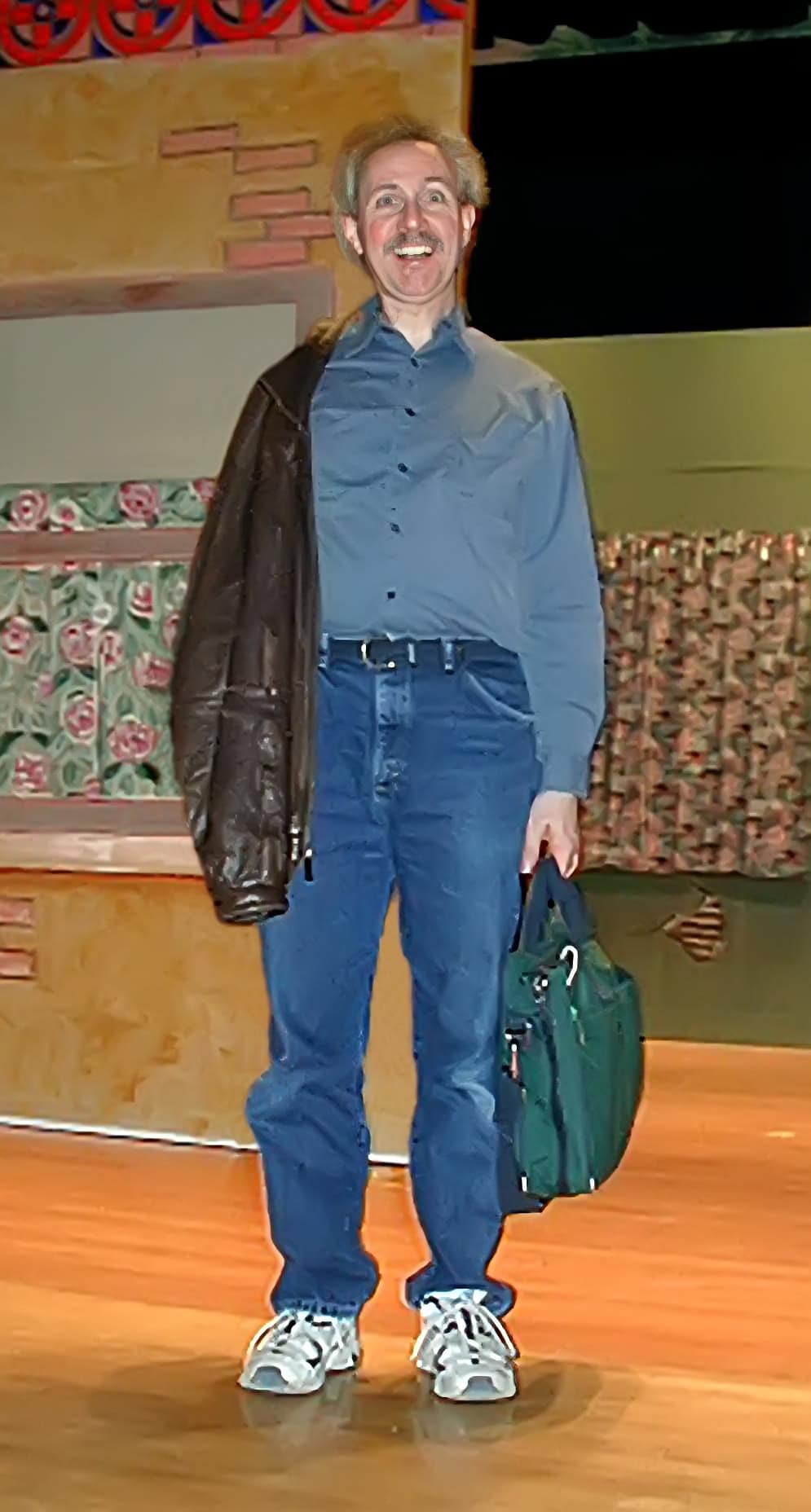
Martin W. Kappel Career Retrospective
Narrated by Martin’s wife, Victoria.
The Story of the KRT
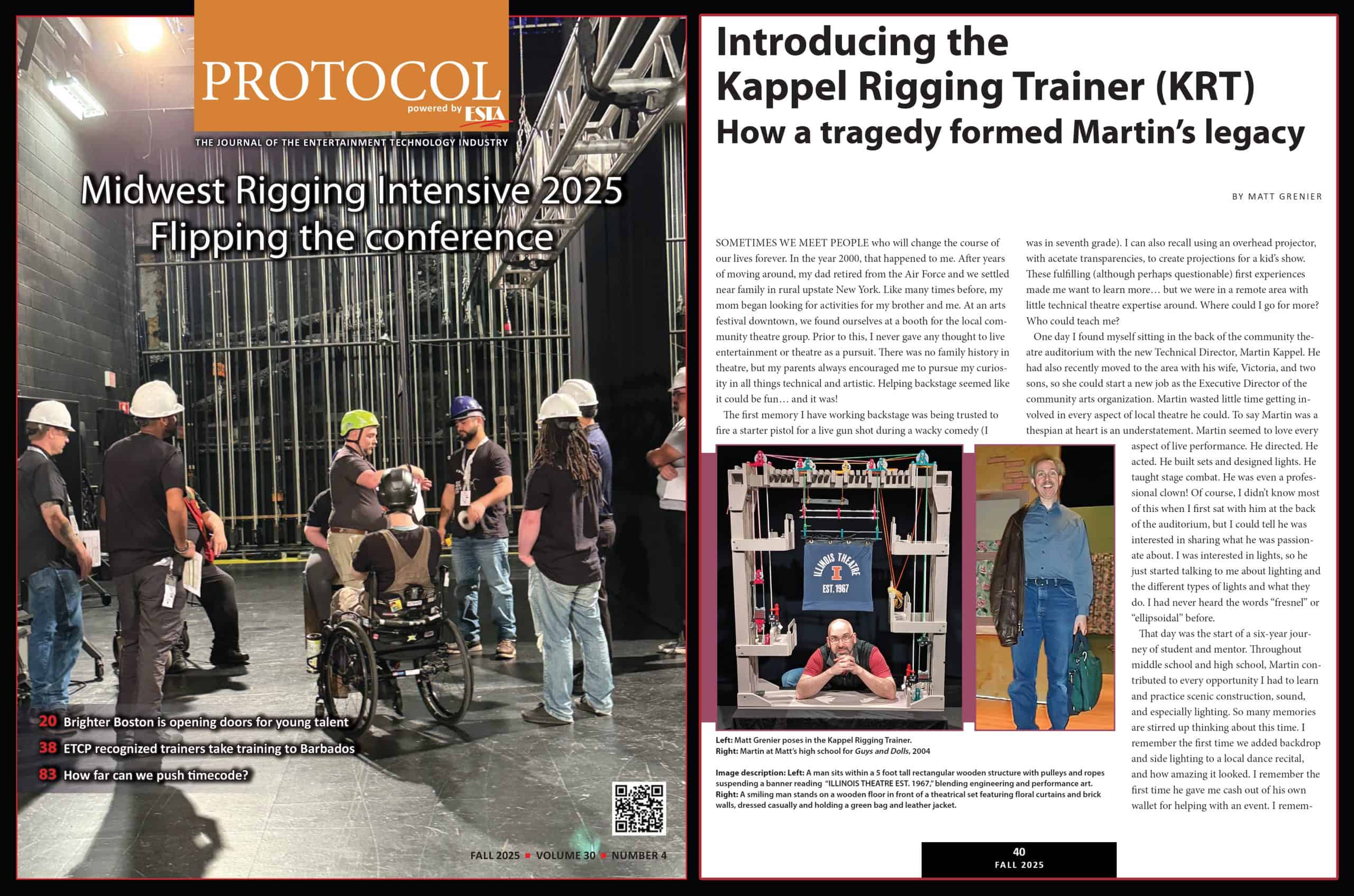
To learn more about Matt and Martin’s story, read the feature article in the fall 2025 issue of ESTA’s Protocol magazine. The article is titled “Introducing the Kappel Rigging Trainer (KRT): How a tragedy formed Martin’s legacy.”‘
The Entertainment Services and Technology Association (ESTA) is a non-profit trade association for the entertainment technology industries.
Matt Grenier
For more information about the designer of the KRT…
Purpose
The fundamental purpose of the KRT is to teach people about manual counterweight rigging systems to help reduce the incidence of injuries caused by improper use. These systems are unique in their risk to operators because they put human hands on heavy, moving equipment which can easily overpower them. Operators often do not have the luxury of standing back and letting a machine do the riskiest part of the work. As discussed in the next section, there are many problems that can inhibit the effective teaching of counterweight rigging.
Other Uses
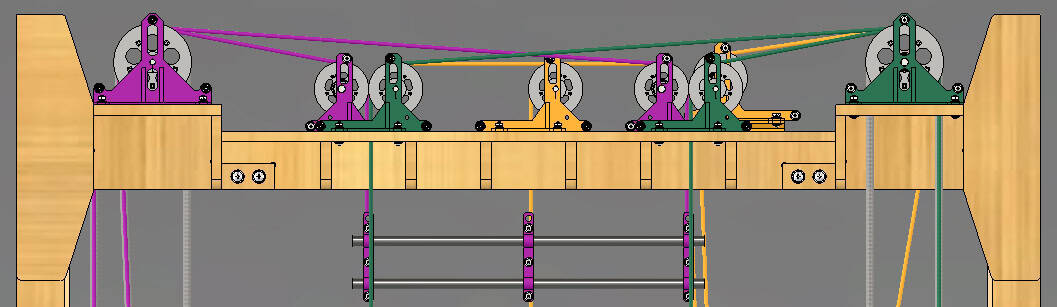
The KRT certainly has educational value beyond manual counterweight rigging operation. The KRT can be leveraged to teach other rigging equipment and concepts including mechanical advantage, motorized rigging, arena rigging, curtain systems, or even performer flying.
The KRT can be used to teach non-theatre people about theatrical rigging systems, including their risks and how/why they are installed into buildings. Safety experts can study hazards specific to theatre rigging. New rigging installers can learn the fundamentals of the equipment they are installing. Structural engineers, architects, buyers, and investors on new theater construction or renovation projects can visualize why the fly tower needs certain features to support the rigging system.
Of course, the KRT can also serve as more of a display or promotional piece. It can be used to promote technical theatre, the arts more generally, or even the maker movement. It can be used to demonstrate other products or equipment.
The KRT holds great promise for builders who want to pursue these other applications.
Problems
There are many problems that can inhibit the effective teaching of counterweight rigging:
- Qualified educators may not have sufficient access to real rigging system(s) due to venue characteristics, scheduling, or the replacement of manual systems with motorized systems
- Qualified educators may be unable to bring their entire class everywhere necessary to see and interact with a real rigging system, especially elevated galleries and the grid
- Students are unable to see all parts of a real rigging system when standing on stage
- Students may struggle to visualize how a system works from pictures or diagrams alone
- Students may not fully engage with training that is all lecture-based
- Students with accessibility needs may be unable to fully participate in hands-on training
- If mistakes are made with a real rigging system, the consequences are high stakes
- Runaways cannot be safely or responsibly demonstrated with a real rigging system
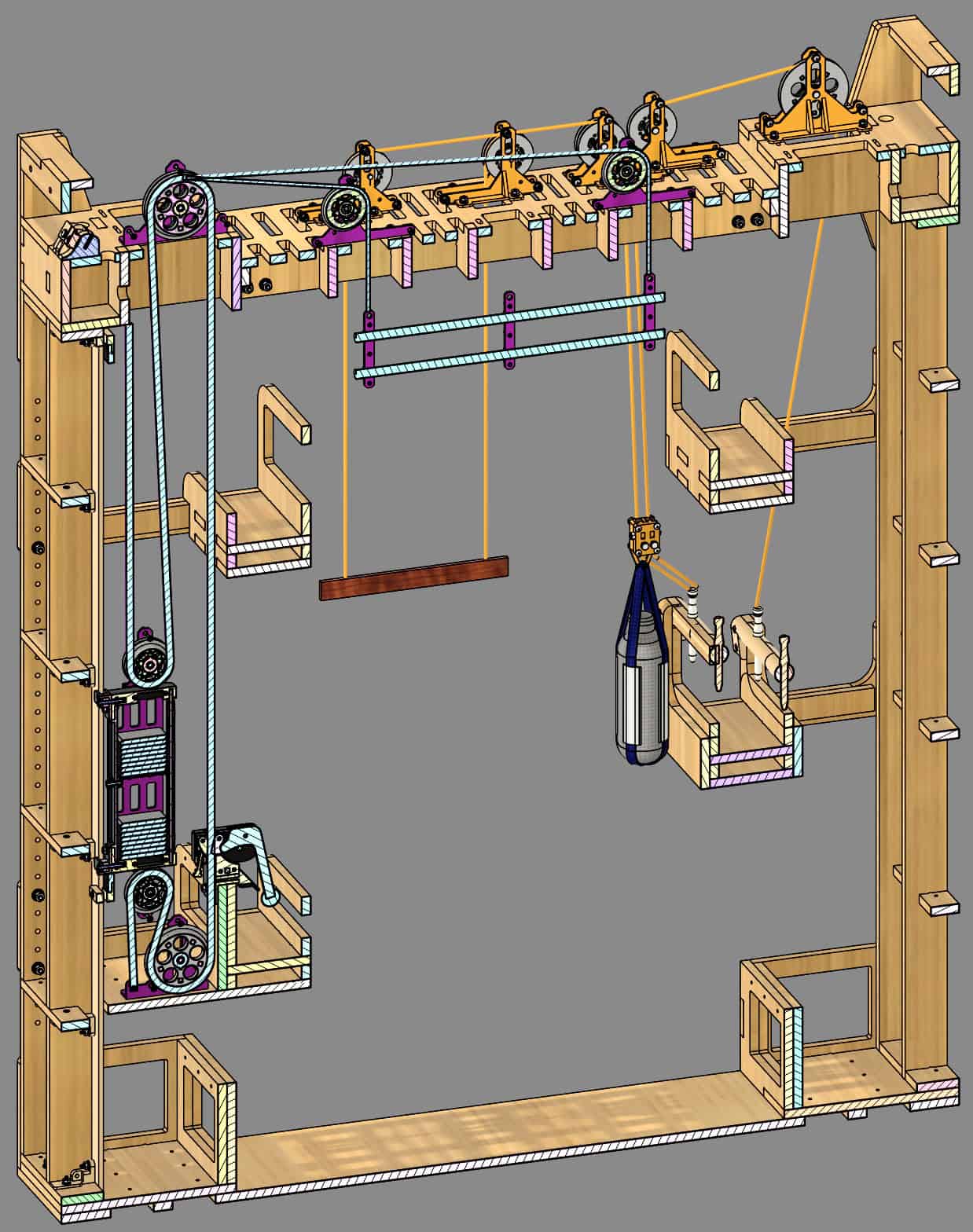
The KRT addresses the above problems as follows:
- Educators now have a functional rigging system they can use whenever they need it
- Educators can now bring their students to every part of the system
- The scale of the trainer allows all parts to be observed at once
- Students can observe the operation of a physical, functional system sitting right in front of them
- Students can engage constructively with the material through hands-on interaction
- Students who cannot physically operate a real rigging system are likely able to operate the trainer. Students who cannot ascend to fly towers, weight floors, or grids can effectively reach those places on the trainer. Students with visual impairments can physically interact with all the parts of the trainer. Students with color blindness can distinguish between the different color-coded line sets of the trainer. Additionally, rigging educators with accessibility limitations can use the trainer to deliver effective instruction even if they have difficulties operating or accessing parts of a real rigging system.
- Mistakes are an important part of the learning process; with the trainer, mistakes can be made with very little risk of injury. Problems with comprehension or execution can be more safely identified when students make mistakes on the trainer before making them on a real system.
- The trainer can actually demonstrate a runaway without inflicting serious injury or damage.
Design Goals
Creating a functional, miniature counterweight system for the classroom requires seemingly endless factors to be considered. There are many different priorities that can be pursued and trade-offs that can be made. Ultimately, the design goals for the KRT were as follows:
- Size the trainer so it is not too large to store and transport easily in a school or classroom environment
- Scale and colorize the parts so they can be distinguished from a distance, even by those with color-blindness
- The parts should look like the real parts (a rope lock should look like a real rope lock)
- The parts should be functional so that they will create behavior analogous to a real system (the rope lock should function like a real rope lock)
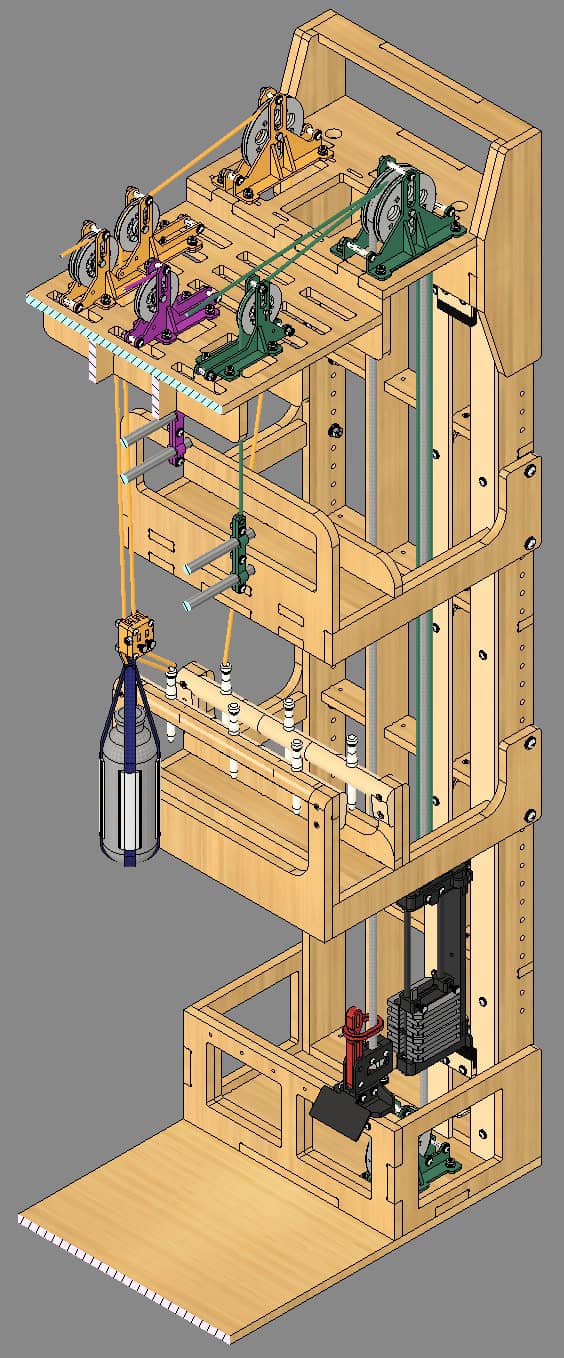
- The trainer should include single, double, and hemp line sets for comparison and discussion of the evolution of rope line systems
- The ropes in the system should be relatively easy to install, tension, and adjust trim with minimal knot tying
- The trainer should include the most common variations of rope locks and counterweight arbors
- The trainer should include accessories needed to teach common operating procedures like loading and unloading battens/counterweight, overhauling to load and unload hard and soft scenery from battens, etc.
- The trainer should be buildable using readily available materials, hardware, and techniques
- The custom plastic parts should be 3D-printable on a typical FDM printer using minimal to no supports
- The trainer should break down into separate tower and grid assemblies without disconnecting or unreeving the operator purchase lines
- The design should anticipate and accommodate open-source modification by users
Project History
For the full story of the KRT’s development, read the feature article in the fall 2025 issue of ESTA’s Protocol magazine. The article is titled “Introducing the Kappel Rigging Trainer (KRT): How a tragedy formed Martin’s legacy.”‘
The Entertainment Services and Technology Association (ESTA) is a non-profit trade association for the entertainment technology industries.
Summary
In the fall of 2024, Matt Grenier began pursuing the KRT as a Graduate Assistantship project while obtaining an MFA in Scenic Technology at the University of Illinois Urbana-Champaign. That academic year, the first version of the KRT was built from custom 3D-printed parts and commonly available scene shop materials using basic techniques and tools. The trainer made its public debut at the Illinois High School Theatre Festival (IHSTF) in January 2025. It was also used to teach counterweight rigging in the Stagecraft and Intro to Stage Rigging courses at the university. Lastly, it was featured at the University of Illinois booth at USITT25 in Columbus, Ohio. In many ways, that first trainer was proof that a miniature rigging system could work and would be an effective teaching tool.
In the spring of 2025, Matt graduated with his MFA and was hired by the university as a Research Specialist to continue development of the KRT. This began the total redesign of the KRT into the refined trainers that are now available. With the generous support of Productions Unlimited, Inc., construction of the physical prototypes began in November 2025. The finished prototypes debuted at the Productions Unlimited booth at USITT26 in Long Beach, California. Productions Unlimited is an entertainment vendor offering a very wide range of services including system integration, rentals, sales, signature product manufacturing, and more. They are based in Roebuck, South Carolina.
As shown in the milestones below, work after USITT26 focused on final adjustments to the design and preparation of the documentation for publishing.
Milestones
Project Launch | September 15, 2024
Design of the first prototype begins with a focus on simple 3D-printing and basic carpentry using commonly available scene shop materials and tools.
- 2024-09-29 – First custom parts are designed, 3D-printed, and assembled (the rope lock)
- 2024-10-06 – Created first prototype single-purchase arbor
- 2024-10-15 – Created first prototype sheaves and pulley block
- 2024-10-20 – Created first prototype double-purchase arbor
- 2024-11-20 – Finished build drawings and began build of wooden frame
- 2024-11-20 – Finished build drawings and beg
- 2024-11-23 – Wooden frame build completed
First Prototype Build | November 2024 – January 2025
The first prototype is built and used to teach counterweight rigging in the fall semester Stagecraft class. The KRT is publicly displayed and demonstrated at Illinois High School Theatre Festival and later at the USITT25 conference in Columbus, Ohio. The KRT is used to teach counterweight rigging in the spring Intro to Stage Rigging class.
- 2024-11-24 – “Final” prototype parts 3D-printed in color PLA
- 2024-12-01 – Counterweights made
- 2024-12-03 – Assembled “final” parts for trainer prototype (rope locks, pulley blocks, arbors, etc)
- 2024-12-04 – First prototype “Uncle Buddy” tool 3D-printed
- 2024-12-04 – Installed 3D-printed parts onto wooden frame
- 2024-12-04 – Conducted functional tests and made loads to hang on the battens
- 2024-12-05 – Used trainer prototype to teach introductory lesson to Stagecraft class
- 2024-12-08 – Made first prototype trim clamp for hemp line set
- 2025-01-06 – Thumb screws 3D-printed for top arbor spreader plates
- 2025-01-06 – Sewed miniature curtains, including pleated curtain with pockets for steel weights
- 2025-01-07 – Dismantled prototype for painting, installed bolts for easier disassembly later
- 2025-01-08 – Painted, clear-coated, and reassembled trainer
- 2025-01-10 – Demonstrated the trainer at the Illinois High School Theatre Festival (IHSTF)
- 2025-02-19 – Used trainer prototype to teach hemp rigging in Intro to Stage Rigging class
- 2025-03-06 – Displayed and demonstrated trainer at USITT25 in Columbus, OH
- 2025-03-31 – Used trainer prototype to teach counterweight rigging in Intro to Stage Rigging class
- 2025-04-08 – Promoted trainer at University of Illinois’ Research Live! speech competition
Complete Redesign | June – October 2025
Design of the KRT is restarted from the ground up with a new focus on optimizing the frame structure for CNC manufacturing. This includes two different frame structures with options for additional line sets. All 3D-printed parts and assemblies undergo major redesign or improvements. New additions are made including a second type of rope lock and compartment-style arbors.
- 2025-06-30 – 2025-07-30 – Conducted extensive redesign work
- 2025-09-13 – 2025-11-12 – Designed the square tube variation of the frame
- 2025-10-01 – Feature article published in ESTA’s Protocol magazine
Prototype Building | November 2025 – March 2026
With the assistance of Productions Unlimited, prototypes of the 3LS and 5LSQ designs are built. They are unveiled at the Productions Unlimited booth at the USITT26 conference in Long Beach, California.
- 2025-11-18 – Began collaboration with Productions Unlimited
- 2025-12-09 – Visited Productions Unlimited in-person to pick up steel and aluminum parts
- 2026-02-14 – Began build of the trainer prototypes (cutting plywood and 80/20 aluminum)
- 2026-02-15 – Assembled plywood parts for flat-pack frame
- 2026-02-16 – Assembled aluminum parts for square stock frame
- 2026-02-24 – Assembled and installed pulley blocks onto trainer frames
- 2026-02-28 – Assembled and installed rope locks and arbors onto trainer frames
- 2026-03-02 – Completed assembly of new prototype trainers
- 2026-03-08 – Sewed new curtains and sandbags
- 2026-03-19 – Displayed and demonstrated trainers at Productions Unlimited booth at USITT26
Design Finalization | March – June 2026
Final adjustments to the design are made in preparation for documentation and publishing. The sheave bearings are entirely reworked. A new floating tension floor block is created. A system of block and tackle is created. New accessories are added to demonstrate flying scenic flats.
- 2026-04-02 – Began design of floating tension floor block
- 2026-04-03 – Tested new sheave hub and bearing design
- 2026-04-04 – Prototype block and tackle parts printed
- 2026-04-14 – Tested first floating tension floor block
- 2026-04-29 – Waterjet-cut new parts for the 5LSQ prototype
- 2026-04-30 – Tested revised floating tension floor block
- 2026-04-30 – Modified compartment-style arbors to be more enclosed
- 2026-05-11 – Replaced sheaves in prototype trainers with new ball bearing design (hemp line sets excluded)
- 2026-05-12 – Assembled final floating tension floor blocks
- 2026-05-12 – Fabricated rope splicing fids for spiking purchase lines
- 2026-05-12 – Installed wire rope lift lines on 5LSQ prototype
- 2026-05-21 – Printed and assembled sawhorses, dolly, and stage jacks
- 2026-06-15 – New axe handle designed and printed
- 2026-07-01 – Reinstalled strip lighting and finalized rigging
Documentation & Publishing | May – July 2026
Final documentation is prepared and published.
- 2026-05-16 – 2026-06-10 – Drawings created, notated, and finalized
- 2026-06-11 – 2026-06-13 – Costing sheet created
- 2026-06-13 – 2026-06-18 – Exported manufacturing files
- 2026-06-20 – 2026-07-10 – Prepared KappelRiggingTrainer.com website
- 2026-06-22 – 2026-07-12 – Wrote and revised KRT Manual
- 2026-07-02 – 2026-07-06 – Collected photos and videos of new prototype trainers